New guide for corporations, foreigners to game U.S. taxpayers
The Obama administration has taken its corporate-welfare road show to Mexico, where American taxpayers funded a three-day conference over the last week, with an aim to simultaneously subsidize U.S. industry while helping Mexico tap into the U.S. Treasury to fund its national infrastructure plan to the tune of hundreds of billions of dollars.
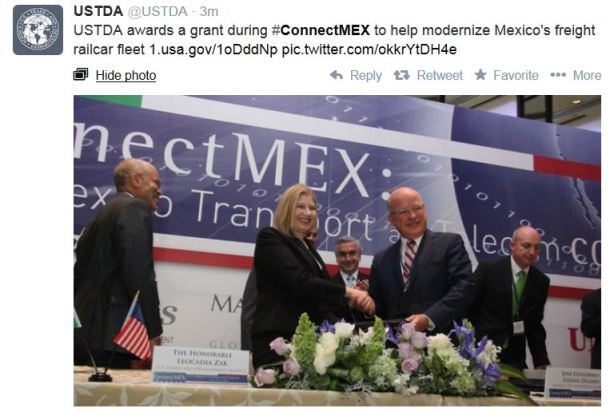
Among the highlights of ConnectMEX – the U.S.-Mexico Transport and Telecom Conference – was the U.S. Trade & Development Agency’s unveiling at this Mexico City venue of a “Resource Guide for U.S. Industry on Priority Infrastructure Projects.”
USTDA – an independent White House agency – in its ConnectMEX promotional materials simply tout the guide as a roadmap containing “detailed descriptions of project opportunities” for the U.S. transportation and telecommunications sectors.
However, the resource guide not only cost U.S. taxpayers $100,000 to create, but serves as a vehicle for both U.S. businesses and the Mexican government to obtain contracts and grants paid for by the American people.
Among potential options for this modernization effort involving hundreds of billions of dollars is financing through governmental institutions such as the U.S. Export-Import Bank, or Ex-Im, and the Overseas Private Investment Corporation, or OPIC.
USTDA in last year’s bid request for the resource guide explicitly directed the contractor to contact Ex-Im Bank, OPIC, and private/commercial institutions to obtain such information on behalf of Mexico, the host nation “Project Sponsor.” The document also specified that the contractor must evaluate this financing data to ensure “which options represent the best value” for Mexico.
“USTDA is sponsoring ConnectMEX to help establish stronger transportation and telecommunications connections between Mexico and the United States,” Director Leocadia I. Zak said during the event’s opening remarks. “We are proud to connect industry-leading U.S. experts to Mexico’s plans to enhance its infrastructure in order to improve the daily lives of its people.”
The amount of that grant – which USTDA is giving to the Asociación Mexicana de Ferrocarriles, Mexico’s national railroad trade association, is unclear, as USTDA announced the grant without revealing its value.
One conference attendee claimed it was a $150 million, though that amount is highly unlikely in the context of past agency grants. An email and separate tweet sent to USTDA was acknowledged, but clarification on the amount was not given by deadline.
The railway grant will support the Mexican industry group’s efforts “to modernize its fleet of specialized freight railcars.
“The project will recommend specific investments in new systems, services, terminals and railcars to meet the projected growth of freight transportation in the country.”
USTDA said it also plans to release “a complete Resource Guide to highlight additional projects in Mexico’s energy, water and environment sectors.”
While USTDA arguably is a relatively small agency – its FY 2014 budget request is just under $63 million – it consistently undergoes criticism along with calls for closure. Former Rep. Ron Paul and free-market think tanks such as the Cato Institute regularly denounce it as among the most duplicative and wasteful of all federal entities.
USTDA, Ex-Im Bank and OPIC consequently are among the most egregious examples of “corporate welfare waste,” the Cato Institute concluded in a 2005 report. These and similar organizations “should be terminated,” contends the report’s author, Chris Edwards.
Totals for previous Ex-Im Bank and OPIC financing of Mexican infrastructure projects were not readily available for this report, but a search of prior USTDA initiatives reveal numerous efforts to arrange U.S. backing of such projects.
USTDA under Obama has financed a multitude of other transportation initiatives that simultaneously benefit the Mexican people and U.S. businesses, courtesy U.S. taxpayers.
Multiple DMs and feasibility studies for airport modernization and expansion initiatives, as well as for numerous environmental endeavors, have received USTDA funding since Obama first took office.
Some of these endeavors precede Obama and took place under the George W. Bush administration.
The agency under Bush was equally generous to the Mexican government, which likewise received grants to explore financing options for infrastructure as well as “green” projects.
Bush’s USTDA in 2006 paid for a DM whose aim was to help Mexico achieve closer parity with the “strength and competitiveness” of the U.S. and Canada¸ its North America Free Trade Agreement, or NAFTA, partners.
Despite the overall viability of this trading block, USTDA at the time lamented that Mexico “suffered from lost manufacturing jobs to Asia and is searching for methods to regain its competitiveness,” according to the DM for the Mexico Secretariat of Communications & Transportation Multimodal National Plan.
“One of Mexico’s solutions to increasing competitiveness is to capitalize on its geographical proximity to the U.S., offering more secure and efficient trade transportation networks with the U.S. and thus Canada,” the agency said in that endeavor.
USTDA similarly financed an analysis of Mexico’s planned modernization of Tijuana as a modern transportation center just south of the California border.
Recently USTDA separately awarded a $50,000 grant to KED Group to assess Mexico’s needs in an “intelligent transportation” project in the State of Jalisco.
The agency last October awarded a $50,000 contract to the Seneca Group to conduct a DM on behalf of the Mexican Association of Railroads. That endeavor’s purpose was to help USTDA decide whether to help fund additional projects supporting “the development of Mexico’s freight rail system, which is a critical component of Mexico’s economy and trade.”
Potential projects were to include assessments of railroad infrastructure “to accommodate the transportation of various oil and gas products.”
It remains unclear whether that project is a predecessor activity to the USTDA grant announced this past week at ConnectMEX. Often the agency will conduct a DM before carrying out a more expensive and detailed feasibility study of the same project.
USTDA separately agreed to provide a $455,000 grant to the State of Puebla Secretariat of Transportation to conduct a feasibility study of a proposed “intelligent transportation system” project.
Puebla authorities reached out to the administration for help because the “demand for public transportation is expected to increase at an even higher rate than its population growth.”
U.S. officials agreed that the development of bus rapid-transit systems along six of the Puebla’s key corridors would “provide significant benefits to Puebla’s population in terms of improved convenience and safety, shorter travel times, and reduced environmental impacts.”
The Monitor's Peacock had reported on those projects as part of a broader review of Mexico-specific, U.S. funded initiatives. However, in contrast to the USTDA intelligent transportation system and railway endeavors – which must hire U.S. contractors — the U.S. Agency for International Development is prohibiting U.S. contractors from participating in a recent assistance scheme.
The ConnectMEX conference was carried out for USTDA by the Business Council for International Understanding, or BCIU, a New York non-profit whose stated objective is to “facilitate dialogue and action between business and government to promote international understanding.”
BCIU is led by Chairman Ahmet C. Bozer, a Turkish businessman and president of Coca-Cola International, as well as BCIU President Peter Tichansky, who also serves on a United Nations advisory board “to build a permanent UN memorial to the trans-Atlantic slave tragedy.”
A similar version of this article originally was published via WND.com on June 1. Under agreement with WND, rights have reverted back to its author, Steve Peacock.


Not Farewell, But See You Elsewhere; U.S. Trade & Aid Monitor to be Archived
Posted: July 2, 2014 in CommentaryTags: @sgpeacock, @tradeaidmonitor, andrew mccarthy, archive, Brianna Keilar, CNN's Situation Room with Wolf Blitzer, Cryptome.org, drudge report, foreign aid, foreign policy, Kenya Sees Spike in Obama Administration-Funded Projects, memoir, Play Dead Roll Over, Steve Peacock, U.S. Trade & Aid Monitor, WND, WND.com
While my creation of U.S. Trade & Aid Monitor has been a fruitful venture — both product-wise and profit-wise — I believe it is time to shift my energies toward other initiatives.
My reporting here immediately had been noticed by WND.com, and since then I have increasingly devoted greater efforts selling original articles to that organization than writing new ones for the Monitor. Indeed, I would like to draw your attention to my WND author page, where the bulk of my recent and future reporting can and will be found.
The Monitor certainly has proved to be a positive experience in digital, independent reporting, as had been its predecessor site, The Peacock Report (which is archived here).
From its inception three years ago, the Monitor has produced hundreds of research-based articles ahead of the competition, at times beating even major media organizations; indeed, news giant CNN — specifically White House Correspondent Brianna Keilar via CNN's Situation Room with Wolf Blitzer — blatantly stole information from this site (see "CNN Rips Off U.S. Trade & Aid Monitor Story on Biden's Plush Parisian Jaunt.")
I must have been doing something right, eh?
Likewise, my articles have been linked to by sources such as Drudge Report, which sparked nearly 90,000 page views in several days in response to "Kenya Sees Spike in Obama Administration-Funded Projects."
Cryptome.org likewise drove thousands of visitors here by linking to my numerous articles on matters specific to national security and U.S.-funded foreign operations.
Similary, bestselling author Andrew McCarthy used (and credited) Monitor material in a piece he wrote for National Review online.
There have been many other notable successes and forms of recognition by outside sources, but it's time I get down to business with other creative ventures (besides, I still have to bag about a ton of leaves in my backyard that I did not get to last autumn).
Most importantly, I need to finish writing Play Dead, Roll Over, my book-length memoir-in-progress. For a taste of the creative nonfiction work, check out an excerpt via Gravel: A Literary Journal and Crime Factory #15. If you are interested in these and other literary (and largely non-political) pursuits, follow me on Twitter via @sgpeacock.
While I will continue to make the Monitor publicly accessible, for now — if not permanently — I will cease posting new articles here.
Stay in touch. Like I said, I expect to continue contributing to WND, so check out my author page for updates.
For those interested in my political writing and in conservative/libertarian issues in general, please follow me on Twitter via @tradeaidmonitor.
In addition to my various writing pursuits, I am likewise pursuing voice-over, acting, and emcee/ring announcer opportunities. I have started to update my YouTube page for that reason, though admittedly it is a work-in-progress.
Best wishes, and thank you all for your support and interest. — Steve Peacock